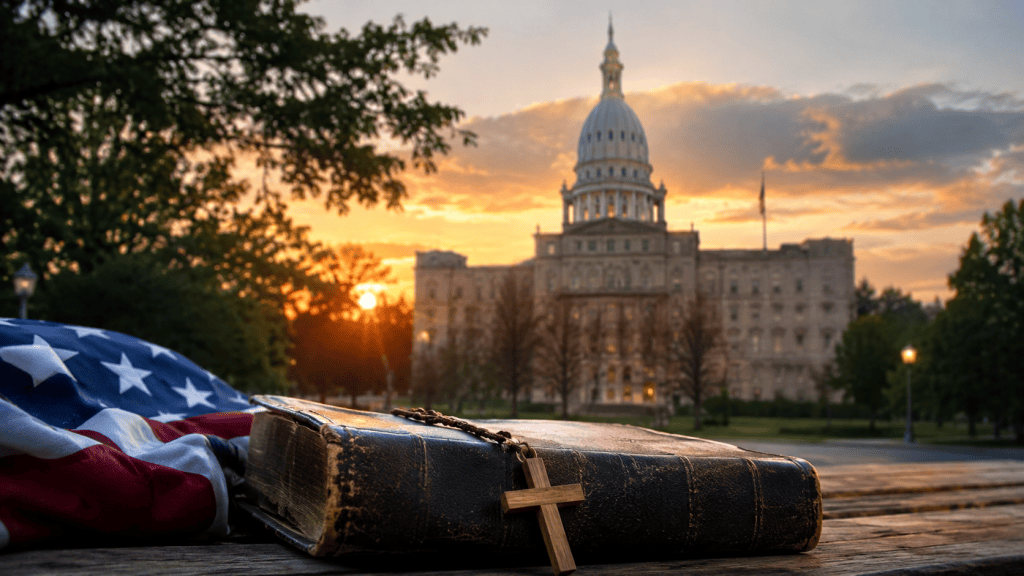
A newly released national report raises questions about religious liberty, church autonomy, and the legal environment facing faith-based organizations throughout Michigan.
MICHIGAN | November 24, 2026
A new report examining religious freedom and the legal environment for faith-based organizations across the United States has placed Michigan at the bottom of its national rankings.
The Napa Legal Institute’s 2026 Faith & Freedom Index gave Michigan an overall score of 34%, ranking the state 51st out of 51 jurisdictions, including all 50 states and Washington, D.C.
The report evaluates state laws and regulations affecting organizations such as churches, religious schools, pregnancy resource centers, homeless shelters, and other faith-based nonprofits.
But what exactly contributed to Michigan’s ranking, and what could it mean for religious organizations and the communities they serve?
What Contributed to Michigan’s Ranking?
According to the Napa Legal Institute, several areas of Michigan law create challenges for faith-based organizations.
The report identifies two broad areas of concern: religious freedom and regulatory freedom.
1. Religious Freedom Protections
Michigan received a score of 24% in the religious freedom category.
Among the concerns identified by the institute are:
– No state Religious Freedom Restoration Act (RFRA): Michigan has not enacted a state law specifically providing additional protections when government action substantially burdens religious exercise.
– Religious exemptions: The institute argues that Michigan’s nondiscrimination laws do not provide sufficiently broad religious accommodations for faith-based employers and organizations offering public programs.
– Emergency protections: Michigan does not have explicit state constitutional or statutory protections specifically addressing religious exercise during a declared emergency.
– Constitutional restrictions: Michigan’s Constitution contains a provision commonly referred to as a Blaine Amendment, which restricts certain forms of public financial support for religious institutions.
The institute argues that these provisions can create conflicts for religious organizations seeking to operate according to their established beliefs and missions.
It is important to note that Michigan’s Constitution does provide protections for the free exercise of religion, and the institute itself acknowledges that Michigan’s Supreme Court has interpreted those protections favorably.
2. Regulatory and Financial Requirements
The report also identifies regulations and financial requirements that can affect religious nonprofits.
Some of the concerns include:
– Financial review and audit requirements for certain charitable organizations raising more than $250,000 annually.
– A 120-day advance notice requirement to the Attorney General for certain major nonprofit corporate actions.
– Limited sales and use tax exemptions for religious organizations.
– Restrictions and application requirements involving certain property tax exemptions.
Not every finding is negative. Michigan automatically exempts qualifying religious organizations with federal 501(c)(3) status from state corporate income tax.
Nevertheless, the institute argues that the combined regulatory requirements make Michigan a more difficult environment for faith-based nonprofits.
How Does Michigan’s Civil Rights Law Factor Into This?
One important piece of legislation involved in this discussion is Michigan’s Elliott-Larsen Civil Rights Act.
In 2023, Michigan lawmakers expanded the law to include sexual orientation and gender identity or expression among its protected categories. Those amendments took effect February 13, 2024.
The law addresses discrimination in areas including employment, public accommodations, education, and housing.
This creates an important legal discussion about how to balance protections against discrimination with the ability of religious organizations to maintain employment, admissions, and organizational policies consistent with their religious beliefs.
The Napa Legal Institute argues that Michigan’s religious exemptions are insufficient.
At the same time, civil rights protections serve an important purpose in protecting individuals from discrimination.
Understanding how these laws interact, and where religious exemptions apply, is essential to understanding the larger debate.
What Does This Mean for Michigan Residents?
It is important to distinguish between a state’s ranking on an advocacy organization’s index and the actual constitutional rights of its residents.
Michigan’s 34% score does not mean residents have lost their First Amendment rights, that churches are prohibited from practicing Christianity, or that religious worship is illegal.
The report primarily evaluates the legal and regulatory environment facing faith-based nonprofit organizations.
However, the questions it raises deserve attention.
How much independence should religious organizations have when establishing policies based on their beliefs?
How should lawmakers balance religious liberty with protections against discrimination?
And what safeguards should exist to ensure that religious organizations can continue serving their communities?
These are questions that affect more than churches. Faith-based organizations often provide food assistance, shelter, charitable services, education, family support, and other resources to people throughout Michigan.
The Bigger Picture
Michigan was not the only state receiving a low score. Washington received 38%, and Massachusetts received 41% and Alabama ranked first with 80%.
The index also demonstrates that religious freedom protections do not necessarily follow traditional political party lines.
It is worth emphasizing that the Faith & Freedom Index is produced by the Napa Legal Institute, an organization focused on helping faith-based nonprofits navigate legal and compliance matters. Its rankings reflect the organization’s chosen criteria and weighting of laws, particularly its emphasis on religious exemptions and organizational autonomy. They are not an official government determination that a state is violating constitutional rights.
Michigan’s ranking provides an opportunity for residents, religious leaders, nonprofit organizations, and lawmakers to examine the laws affecting religious institutions and consider where additional clarity or protections may be appropriate.
Staying informed means understanding not only what is happening, but also what the facts, laws, and original sources actually say.
The Watchkeepers Post | Independent Reporting. Informed Citizens. A Watchful Nation.


Leave a Reply